SSL Management
It provides functionality to support SSL offloading based on configurations.
Overview
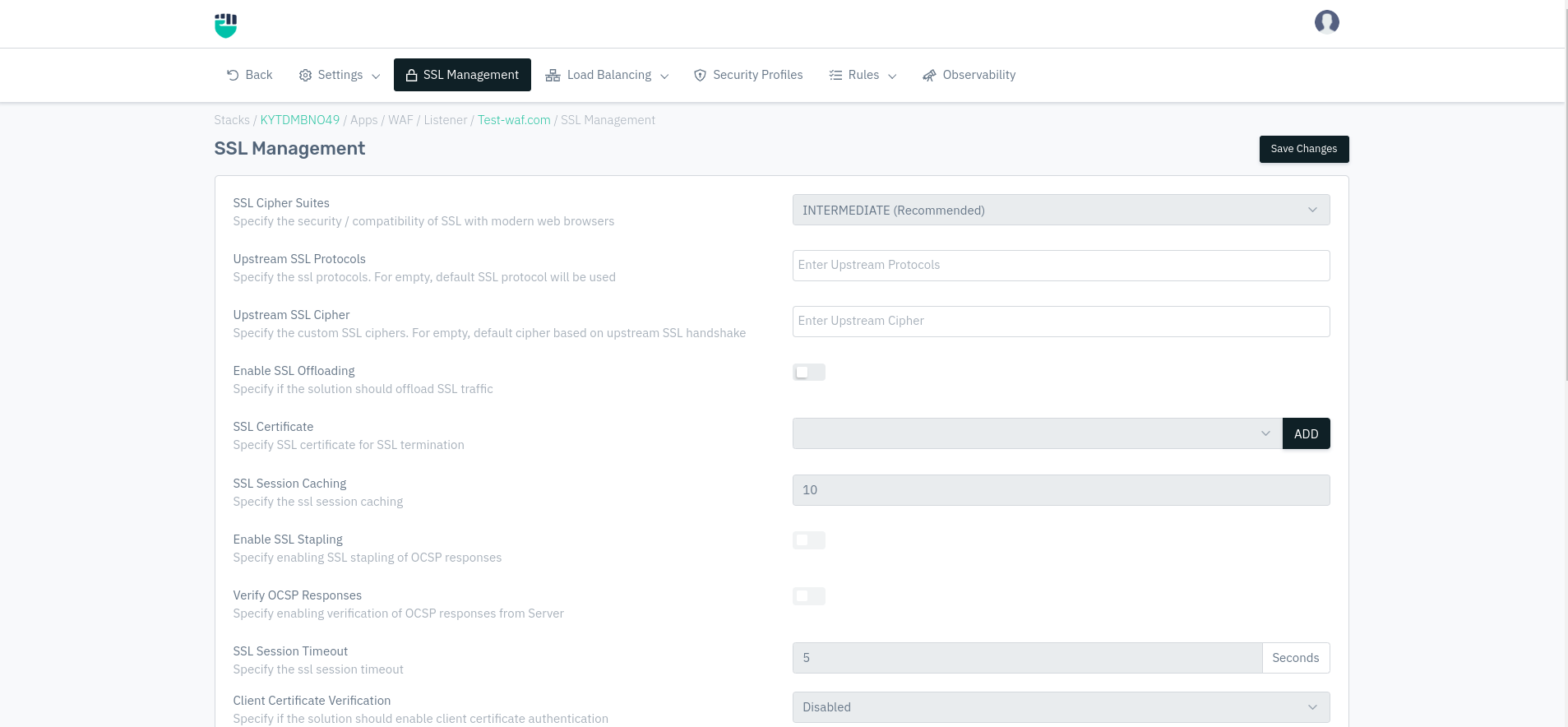
As many applications are running over SSL/TLS, for the WAF / ADC solution to inspect user payload, it is necessary to decrypt SSL/TLS traffic. The following settings allow users to configure SSL offloading based and optional re-encryption in Haltdos solution. The performance of SSL offloading will vary based on chosen model.
How to Use:
- Go To WAF > Listeners > SSL Settings
- Configure Your Settings
- Click Save Changes.
Encrypt Traffic to Upstream
This specifies WAF should re-encrypt traffic before sending it to the back-end web application.
SSL offloading is supported to secure traffic by encrypting plain text over SSL/TLS, as well as other protocols such as SMTP, IMAP, and POP3.
Description
SSL Ciphers Suites
In order to secure or make SSL compatible with specific web browsers. Users can select from the drop-down i.e. Modern(Very Secure), Intermediate (Recommended), Old(Backward Compatibility), Custom, etc.
    Accepted values: Modern / Intermediate / Old / Custom

    Default: Intermediate
SSL Ciphers
It is a set of algorithms or a set of instructions/steps that helps to establish a secure connection between two entities — usually the client (a user's browser) and the web-server they're connecting to (your website). Users can select respective ciphers from the drop-down.
Upstream SSL Protocols
This option specifies if the WAF should enable SSL session for the configured website.
    Accepted values: SSLv2 / SSLv3 / TLSv1 / TLSv1.1 / TLSv1.2 / TLSv1.3

    Default: Blank
Upstream SSL Cipher
Specify the custom SSL ciphers. For empty, default cipher based on upstream SSL handshake
    Accepted values: Select SSL Cipher

    Default: Blank
Enable SSL Offloading
This option specifies if the WAF should enable SSL offloader for the configured application.
    Accepted values: Enable / Disable

    Default: Enable
SSL Certificate
This field allows us to Select or Upload an SSL Certificate for SSL Offloading in case of encrypted traffic. Users can select the SSL certificate from the drop-down or add a new certificate by clicking the ADD button which will redirect to the SSL Certificates page
    Accepted values: Select the uploaded SSL Certificate

    Default: Blank
SSL Session Caching
This option allows users to specify the number of SSL session cache for SSL/TLS transactions on the listener.
    Accepted values: Integer

     Max: 1000

     Min: 0

    Default: 10
Enable SSL Stapling
Specify enabling SSL stapling of OCSP responses
    Accepted values: Enable / Disable

    Default: Enable
Verify OCSP Responses
Specify enabling verification of OCSP responses from Server
    Accepted values: Enable / Disable

    Default: Enable
SSL Session Timeout
For https, this option allows users to specify the SSL session timeout in minutes for every SSL/TLS transaction on the listener.
    Accepted values: Integer

     Max: 3600

     Min: 1

    Default: 5
Metrics: Seconds
Client Certificate Verification
This option specifies if the solution should enable client certificate authentication.
    Accepted values: Enabled / Disabled / Optional

    Default: Disabled
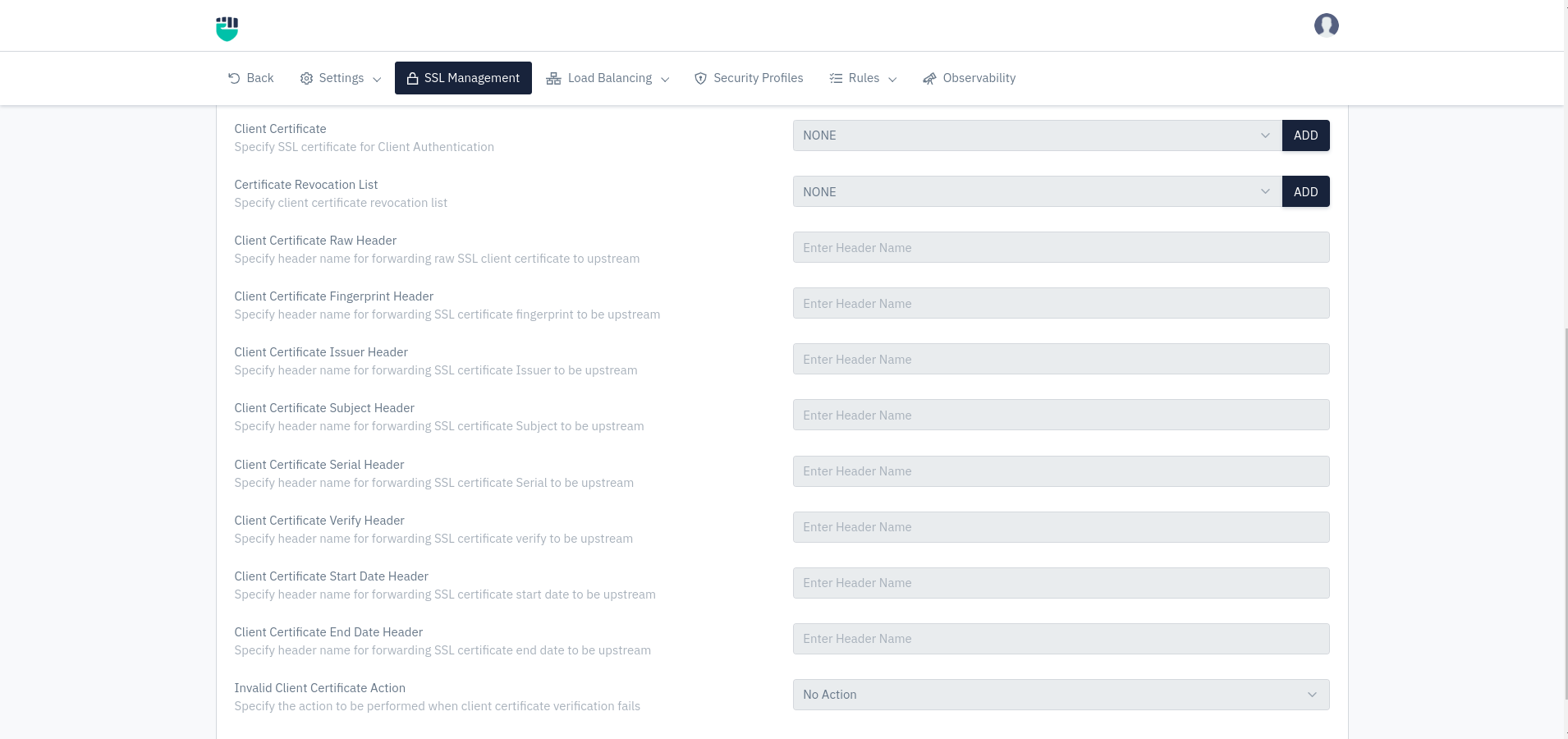
Client Certificate
This option specifies an SSL certificate for Client Authentication.
    Accepted values: Select Client Certificate

    Default: Blank
Certificate Revocation List
Specify client certificate revocation list
    Accepted values: Select Revocation List

    Default: Blank
Client Certificate Raw Header
Specify header name for forwarding raw SSL client certificate to upstream
    Accepted values: String

    Default: Blank
Client Certificate Fingerprint Header
This option specifies header name for forwarding SSL certificate fingerprint to be upstream
    Accepted values: Select certificate revocation list

    Default: NONE
Client Certificate Issuer Header
This option specifies header name for forwarding SSL Certificate Issuer to be upstream
    Accepted values: String

    Default: Blank
Client Certificate Subject Header
It specifies header name for forwarding SSL certificate Subject to be upstream
    Accepted values: String

    Default: Blank
Client Certificate Serial Header
This option specifies header name for forwarding SSL certificate Serial to be upstream
    Accepted values: String

    Default: Blank
Client Certificate Verify Header
This option specifies header name for forwarding SSL certificate verified to be upstream
    Accepted values: String

    Default: Blank
Client Certificate Start Date Header
This option specifies header name for forwarding SSL certificate start date to be upstream
    Accepted values: String

    Default: Blank
Client Certificate End Date Header
This option allows user to add header name for forwarding SSL certificate end date to be upstream.
    Accepted values: String

    Default: Blank
Invalid Client Certificate Action
This option allows user to specify the action to be performed when client certificate verification fails.
    Accepted values: No Action / Tarpit Src IP / Send Custom Response / Temprorary Blacklist IP / Terminate Connection / Redirect / Record Request / Record Request & Drop

    Default: No Action